Structural Drying and Dehumidification in Sandy, UT
Surface dry is not dry. The drying team dries framing, subfloor and wall cavities, and equipment stays until the readings match a dry reference, not until the room looks dry.
(888) 558-4812Get the structure dried to standard in Sandy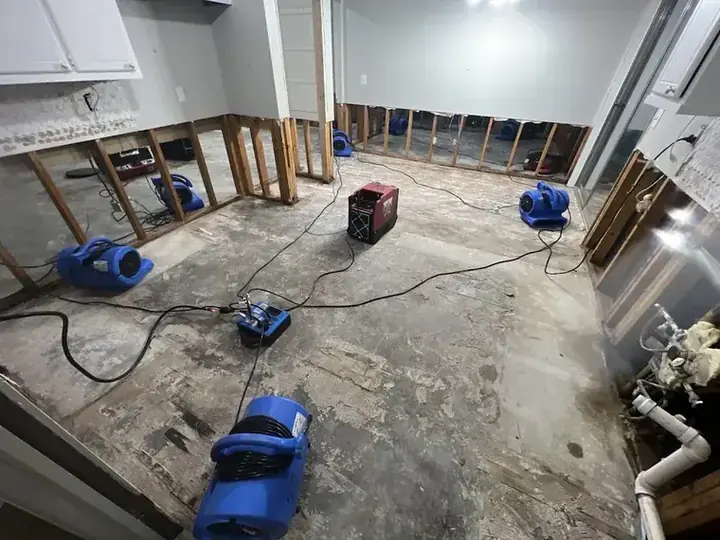
What to do when a wet house needs drying in Sandy
- Keep the heat on Moderate indoor heat helps evaporation; do not turn it off.
- Leave equipment running Air movers and dehumidifiers work around the clock; do not switch them off at night.
- Keep doors as set The drying team closes or opens rooms on purpose to control the air.
- Empty nothing yourself Most dehumidifiers drain by hose; tell the crew if one stops.
How structural drying is handled in Sandy, step by step
Mapped before anything moves
The tech who does the walkthrough traces how far the water traveled, including into subfloor, baseboard and wall cavities, so the plan matches what is actually wet.
Dried as a structure
The drying team sizes air movers and LGR dehumidifiers to each room's class of loss, and dries framing and cavities, not just the surfaces you can see.
Documented for the claim
The restoration team keeps a moisture map, daily psychrometric readings and timestamped photos taken before any material comes out.
What does structural drying and dehumidification cost in Sandy, UT?
In Sandy, UT, structural drying typically runs $800 to $5,000 on its own, on top of extraction. The drivers are the class of loss, the square footage, the materials involved and how many days of equipment it takes to reach the drying goal.
Class 1, one room
- 2 to 4 air movers
- One LGR dehumidifier
- Daily readings
Class 2 to 3, a level
- Cavity drying
- Several LGR units
- Psychrometric logs
Class 4, dense materials
- Hardwood drying mats
- Desiccant dehumidifiers
- Extended monitoring
For a planning range on your own loss, try the water damage cost calculator. The restoration contractor who responds sets the real scope after the moisture map.
The structural drying process in Sandy, UT
- 1
Moisture mapping
The tech who does the walkthrough maps wet materials with pinless meters and a thermal camera before any equipment goes down.
- 2
Extraction
The extraction crew pulls standing water with truck-mounted units, so it leaves the building instead of spreading into the next room.
- 3
Air movers and LGR
Air movers go in at each room's evaporation load while LGR dehumidifiers pull that moisture back out of the air.
- 4
Dry verification
Readings are logged daily, and the drying team pulls equipment only when materials sit within the IICRC S500 drying goal.
Structural drying is the part of a water loss that decides whether problems show up months later: swollen baseboards, cupped floors, musty odors and mold in the wall. IICRC S500 is the industry drying standard, and it treats drying as a measured process with a goal, not a set number of days.
How the drying plan is built
- Moisture mapping with pinless meters and a thermal camera, before any equipment goes down
- A dry reference reading taken from unaffected material in the same building
- The class of loss, 1 through 4, which sets how much evaporation the room needs
- Air movers placed at the evaporation load of each room, aimed along wet walls
- LGR dehumidifiers sized to the room volume, with desiccants for dense Class 4 materials like hardwood and plaster
Daily readings and the drying goal
The drying team returns each day to take readings of the wet materials and the air: temperature, relative humidity and grains per pound. Those psychrometric readings show whether the equipment is working and whether it needs to move. Equipment comes out when wet materials sit within 2 to 4 points of the dry reference. A contained Class 1 loss usually gets there in three to five days; hardwood, plaster and multi-layer floors take longer.
Already had water extracted but the house still smells damp? Readings show what is still wet.
Call about structural drying in Sandy, (888) 558-4812Dry Utah air helps, cold basements do not
Salt Lake Valley air is dry most of the year, which helps evaporation. Cold winter basements and damp spring slabs slow it down, which is why the drying team works to readings instead of a calendar. EPA mold guidance explains why materials need to dry quickly, and Utah State University Extension covers home moisture in Utah conditions. Drying follows water extraction on every job; see the drying-time estimator for a planning range.
Water damage help across Sandy and the south valley
The restoration team covers every Sandy ZIP, 84070 and 84090 to 84094, from South Towne to the Bell Canyon trailhead, plus Draper, South Jordan, Midvale and Cottonwood Heights.
See every neighborhood and ZIPRelated water damage services in Sandy
Structural Drying and Dehumidification questions in Sandy, UT
What does drying to the IICRC S500 standard mean?
It means the dry-out follows the industry standard for categorizing water, classing the loss, sizing equipment and verifying dryness with readings against a dry reference.
Why can't I just open the windows and use fans?
Fans move surface moisture but do not remove it from the air or dry framing and cavities. Without dehumidification the moisture moves into other materials.
How is dry actually confirmed?
Readings of wet materials are compared with a dry reference in the same building. Equipment comes out when wet materials read within 2 to 4 points of it.
What is a Class 4 loss?
A loss involving dense materials that hold water tightly, like hardwood, plaster and concrete. It usually needs desiccant dehumidifiers and more time.
Why is the equipment so loud?
Air movers push a lot of air across wet surfaces. The noise lasts only a few days, and turning equipment off slows drying.
Does structural drying prevent mold?
Drying wet materials quickly is the most effective way to keep mold from starting, since mold needs lasting moisture to grow.
Structural Drying and Dehumidification in Sandy, day or night
Water keeps moving into drywall, pad and framing until someone pulls it out. The Sandy restoration crew extracts, dries to the S500 goal and documents the loss.
- Sandy, UT and the south valley
- Open 24 hours, 7 days